By Tom Swanson, Senior Engagement Manager at Heinz Marketing
Marketing workflows, as with most workflows, tend to follow a set of linear steps. Branches and forks are all good, but generally each step relies on some output from the step before it. If those outputs get messed up, then it is hard to tell if the whole flow is bad or if it is a much smaller problem.
In a marketing system, that bad output can create layers of habits on top that then make the issue much harder to root out and solve.
That is a flowery way of saying that underlying issues + habits create bad workflows.
If you are looking to improve your marketing workflow, then what I am going to do for you here is lay out a way to do it. This is how we go about identifying, diagnosing, and solving issues such that we can root out real problems from just bad habits that have been built in response to bad inputs.
Furthermore, if you want to include AI in your marketing workflows, then you will still need to do this work. AI might be a way to solve a bad input problem, but if you don’t know where the problem really starts then you are wasting time, effort, and resources.
If you take one thing away from my post today, let it be this: when solving problems in a marketing workflow, start from the point of fewest assumptions (usually this is the beginning of the workflow) and solve problems sequentially from there.
Of course you could always just hire an army of project managers, too.
Anyway, let’s get into it.
Examine your current state
What is going on right now? Can your team even absorb another change? Is there appetite for a fix to a workflow? Talk to your team and ask them these questions.
Most of the time we come into an orchestration problem and we find that there is a ton already changing or having recently changed. Change fatigue is a real risk to any change effort, especially for marketing teams where change is near constant in the work itself.
This even more of a concern when you have a team that serves as a central shared resource for other teams. A common example of this is a central creative team servicing marketing and corporate teams. These folks tend to burn out fast because of the constant changes of hierarchical stakeholder demands.
Ick.
If your team has absorbed a ton of change recently, it is going to be hard to diagnose an issue. It could just be that all of the recent changes need to settle and your team needs time to set into a rhythm. Making more changes could just make things worse.
Sometimes patience is the answer. Give it a quarter.
Avoid prioritizing problems by impact size
Teams always bring up problems to us based on the size of the impact they have. This is very normal, because people think about the pains they are feeling.
It is very easy to lose sight of the true problems when you are looking at the biggest pain points.
If you have a headache, you are going to complain about the headache. You probably aren’t going to complain about the fact that you have had bad posture for 25 years… not that I would know anything about that.
When the problem is the posture, but you take Tylenol for the headache, your head will feel better today but you will get another headache. And 20 years from now you’ll be hunched over permanently.
This is the problem with prioritizing problems by impact size. Much like the body, your workflow might have bad root posture that is causing things to be much worse further down the line.
Like a doctor, our job (and yours in this work) is to see the pain points as the symptoms they are.
Begin improving a workflow at intake
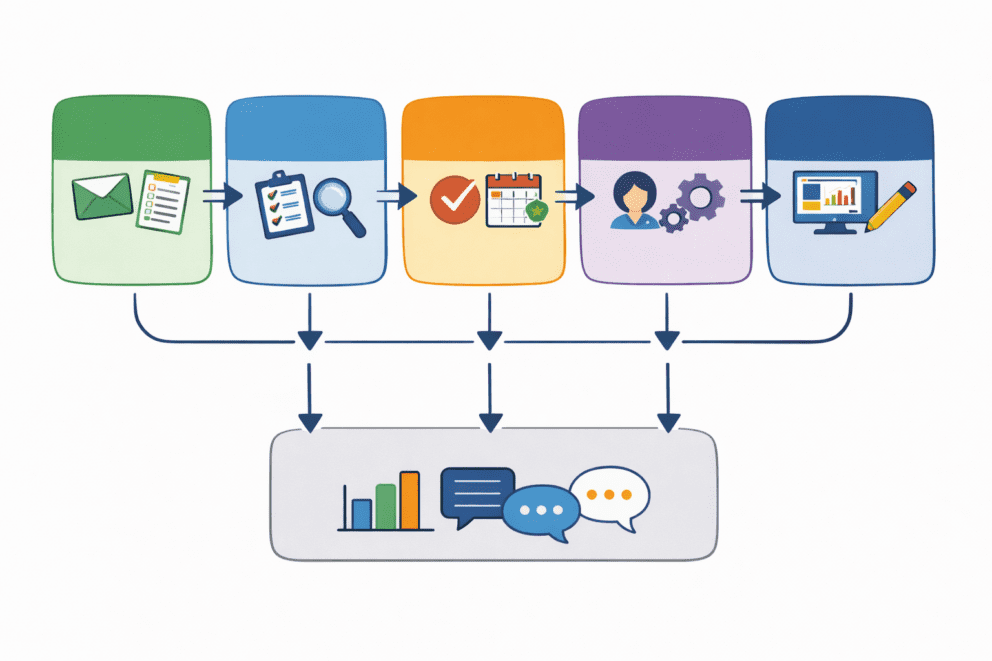
Assuming your team has an appetite to fix this problem, or that this problem has been going on for a quarter, then you want to begin by looking at intake.
- Does everyone have all of the information they need to start a project?
- Is anyone finding out about projects too late?
- Does everyone know what to do and what their part is?
- How much time is spent hounding down information?
- Do contributors understand stakeholder needs?
- Is priority clear?
I can almost guarantee you that the answer to the first and last of those questions is going to be an emphatic “no”.
Here is the tough thing about intake: if you get this wrong, you won’t know if every other issue is its own thing or just part of the broader “garbage-in, garbage-out” problem. This is why you start with intake.
Solve the problems with intake first. Then give your team a few runs through the workflow.
Occam’s Razor
When you start at the beginning of the workflow, you get access to one of the best problem-solving tools: Occam’s Razor.
For the unfamiliar, Occam’s Razor is a problem-solving principle that essentially states that you should start solving problems from a place of fewest assumptions.
When you examine problems downstream in a workflow, there are many, many assumptions about what information people are working from. Here are just a few:
- The information coming in was correct at the start
- Everyone is working from the same information
- All of the stakeholders are known
- The marketing teams are clear on what is needed from them
- The marketing teams know the audience
But here is the biggest assumption:
Assumption: Any issue that comes up is NOT the result of incomplete information or poor communication at intake.
Until that assumption is dealt with, you cannot know if your diagnosis is accurate or if you are just using band-aid solutions.
The point
Solving problems in a workflow is like anywhere else. You need to examine your assumptions and start from the place where you have the fewest. Most of the time, this is going to be the very beginning of the workflow.
Incomplete information and poor communication are the root cause of 90% of the problems we see. If you want to effectively deal with these, we can help you. Come talk to us at acceleration@heinzmarketing.com
The post Improving Your Marketing Workflow the Right Way appeared first on Heinz Marketing.